
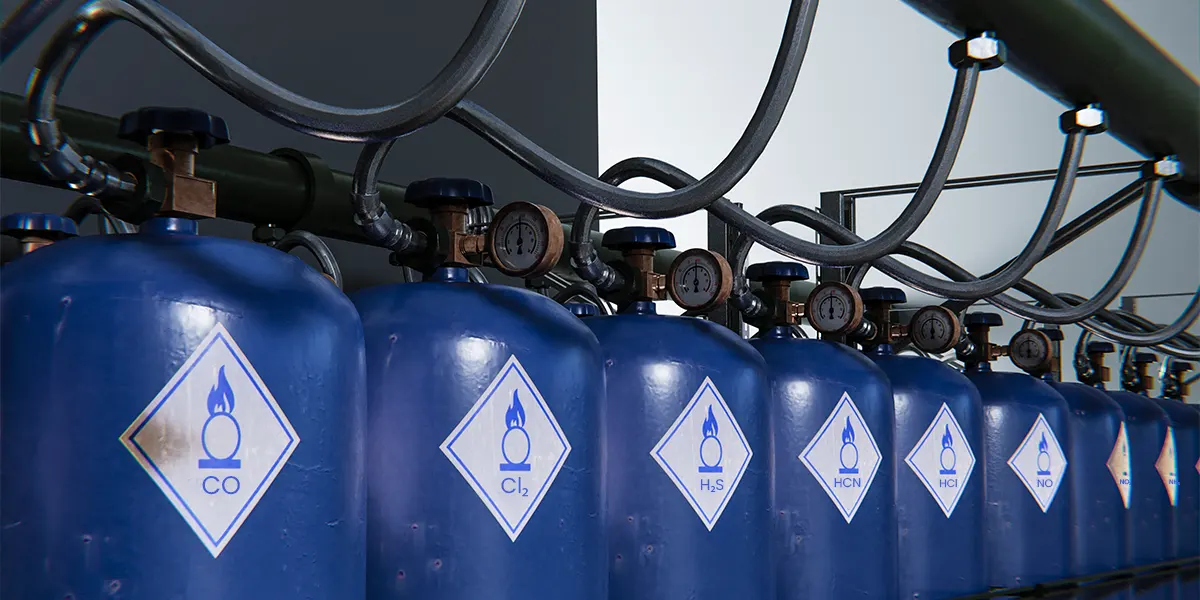
Calibration Gas Mixtures
Calibration gases are accurately formulated gas mixtures used as reference standards to calibrate and validate the performance of gas detection instruments, including gas analyzers, sensors, and detectors. These gases ensure that measurement devices deliver precise and consistent readings, which is essential in environments where gas monitoring is critical for safety, regulatory compliance, and environmental protection. Commonly used in industries such as oil and gas, manufacturing, healthcare, and environmental monitoring, calibration gases play a vital role in maintaining the reliability and accuracy of gas detection systems.
Key aspects of calibration gases:
- Purpose: Calibration gases are used to calibrate instruments by providing a known concentration of a specific gas or a mixture of gases. This process ensures that the instrument’s sensors respond accurately to different gas concentrations.
- Types: Calibration gases can be single-component (e.g., pure methane, carbon monoxide) or multi-component mixtures. The specific gases used depend on the application and the type of instrument being calibrated.
- Traceability: Calibration gases should be traceable to a national or international standard, ensuring the accuracy and reliability of the calibration process.
- Examples: Common calibration gases include methane, carbon monoxide, hydrogen sulfide, oxygen, and various other gases depending on the application. For example, methane is often used for calibrating combustible gas detectors, while hydrogen sulfide is used for detectors that monitor hydrogen sulfide levels.
- Applications: Calibration gases are used in a wide range of industries, including oil and gas, emergency services, environmental monitoring, and various industrial settings where gas detection is essential.
- Traceability: Calibration gases are traceable to national or international standards, meaning their composition and concentration are certified to be within a specified range of accuracy.
- Importance: Calibration gases play a vital role in maintaining the accuracy and reliability of gas detection equipment, which is crucial for safety and regulatory compliance.
| Component | Concentration | Balance |
|---|---|---|
| Ammonia | 10–500 ppm | Air or Nitrogen |
| Chlorine | 2–1000 ppm | Nitrogen |
| Carbon Monoxide | 10–2000 ppm | Air or Nitrogen |
| Ethylene Oxide | 5–100 ppm | Nitrogen |
| Hydrogen Cyanide | 5–20 ppm | Nitrogen |
| Hydrogen Chlorine | 3–1000 ppm | Nitrogen |
| Hydrogen Sulfide | 5 ppm–1% vol. | Air or Nitrogen |
| Nitric Oxide | 5–900 ppm | Nitrogen |
| Phosphine | 0.15–15 ppm | Nitrogen |
| Silane | 5–10 ppm | Nitrogen |
| Sulfur Dioxide | 2–100 ppm | Air or Nitrogen |
| Component | Concentration | Balance |
|---|---|---|
| Benzene | 1–5 ppm | Air |
| Butane | 10 ppm – 0.9% vol. | Air |
| Carbon Dioxide | 50 ppm – 100% vol. | Air or Nitrogen |
| Ethylene | 10 ppm – 1.35% vol. | Air |
| Helium | 100% vol. | N/A |
| Hexane | 10 ppm – 0.48% vol. | Air |
| Hydrogen | 10 ppm – 2.0% vol. | Air or Nitrogen |
| Isobutylene | 10 ppm – 100 ppm | Air |
| Methane | 10 ppm – 2.5% vol. | Air or Nitrogen |
| Methyl Chloride | 10 ppm – 300 ppm | Air |
| Methylene Chloride | 10 ppm – 200 ppm | Air |
| Oxygen | 0.4% – 100% vol. | Nitrogen |
| Pentane Chloride | 10 ppm – 0.75% vol. | Air |
| Propane Chloride | 10 ppm – 1.1% vol. | Air |
| Propylene | 50 ppm – 5.6% vol. | Nitrogen |
| Toluene | 10 ppm – 100 ppm | Air or Nitrogen |
| Zero Air | 20.9% Oxygen | Nitrogen |
| Nitrogen | 100% vol. | N/A |